


Wet Granulation Systems for Pharmaceutical Manufacturing with IBCs
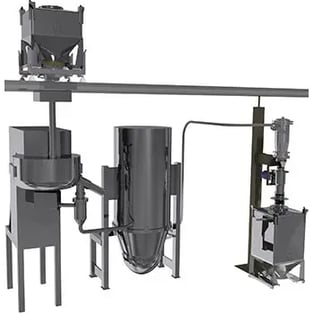
The manual, time-consuming dispensing operation can be carried out away from the granulator, with the IBC then brought in to feed directly via gravity. The Matcon system is a closed system, so it keeps dust to a minimum and protects both operators and product quality throughout the process.
When compared with drum tipping or vacuum transfer, the overall throughput of a granulation system using Matcon IBCs can be improved by an estimated 10 to 30%, because the system can be automated for feeding to the granulation process. In multi-product facilities, it is also quicker to make frequent changeovers, which means less downtime and more time producing.
How Does the Cone Valve Improve Wet Granulation?
The Matcon Cone Valve IBCs provide full discharge of all powders. They have been proven to deal effectively with even sticky materials such as metformin, without the need for operator intervention. A full granulation lot can be discharged automatically, completely, and rapidly.
Unlike vacuum transfer systems, Cone Valve IBCs do not cause choking or dusting during discharge. This means cleaner operation, more consistent powder flow, and fewer stoppages on the line. For pharmaceutical manufacturers handling sensitive active ingredients, this level of control is essential for maintaining product integrity and meeting regulatory standards.
Related Processing Steps
Click on the links below to access the other processing steps:

Key Features of the Matcon Wet Granulation System
- Automated discharge process
- Contained transfers with minimal dust exposure
- Single-floor and through-floor versions available
- Custom designed to suit your facility layout
- Cone Valve technology for complete IBC emptying
- Suitable for sticky and free-flowing powders alike
Why Use IBCs Instead of Drums or Vacuum Transfer for Granulation?
Switching from drums or vacuum transfer to an IBC-based system brings practical gains across the entire granulation process. IBCs remove the need for manual handling at each transfer point, which reduces labour costs and lowers the risk of operator exposure to active pharmaceutical ingredients. The closed system design also keeps contamination risk low, which is critical in pharmaceutical environments.
Automation is another significant benefit. Because the IBC feeds directly to the granulator by gravity, the process runs with less manual oversight. This supports higher overall equipment effectiveness (OEE) and allows production teams to focus on higher-value tasks.

How Does a Closed IBC System Protect Product Quality in Granulation?
In wet granulation, powder exposure during transfer is one of the most common sources of quality issues. Open transfers allow moisture ingress, cross-contamination, and active ingredient loss, all of which can compromise the finished tablet. A closed IBC system eliminates these risks by keeping the powder contained from dispensary through to granulation.
The Matcon system is designed so that powder never comes into open contact with the surrounding environment during transfer. This is particularly important for high-potency active pharmaceutical ingredients (APIs), where even trace exposure can be a health and safety concern. The result is a more consistent granulation feed, better batch uniformity, and a cleaner facility overall.
Quadro Solutions for Wet Granulation
Quadro Engineering, another business unit of IDEX MPT, is the trusted provider of milling, screening and size reduction equipment. Backed by 50+ years of experience, Quadro mills are well known for meeting the pharmaceutical industry's most rigorous quality control and cGMP standards, ensuring reliability regardless of project size.

WHITEPAPERS
A Better Way To Handle Tablets Using IBCs
Handling tablets in larger batches reduces the labour needed to move containers and make or break connections. It leads to improved control and traceability across the production process. When combined with Matcon's IBC system, manufacturers can move more product with fewer people and fewer manual steps.
To understand how IBC-based tablet handling fits into a broader pharmaceutical production strategy, explore pharmaceutical manufacturing best practice.

Frequently Asked Questions About Pharmaceutical Dispensing:
Wet granulation is used to improve the flow and compressibility of powder blends before tablet pressing. It involves adding a liquid binder to dry powders to form granules, which are then dried and milled before compression. It is one of the most common methods for producing tablets where the active ingredient does not compress well in its original powder form.
Based on comparisons with drum tipping and vacuum transfer methods, switching to a Matcon IBC-based granulation system can potentially improve overall throughput by an estimated 10 to 30%. This comes from automated feeding, reduced manual handling steps, and faster changeovers between product batches.
Yes. The Matcon Cone Valve IBC technology has been proven to discharge sticky materials such as metformin fully and automatically, without operator intervention.
The Cone Valve design prevents bridging and ensures complete emptying of the IBC on every cycle.

A single-floor system operates entirely on one level, with the IBC and granulator positioned on the same floor.
A through-floor system uses gravity by positioning the IBC on an upper level to feed the granulator below.
Both configurations are available with the Matcon system and are designed to suit the layout of your existing facility.
More detail is available on single versus two-floor pharmaceutical facility options.
The closed design of the Matcon IBC system minimises powder exposure, reduces cross-contamination risk, and supports full batch traceability. These features align directly with cGMP requirements for pharmaceutical manufacturing. Contained transfers, automated discharge, and easy-clean IBC designs all contribute to a facility that is simpler to audit and validate.
Yes. Matcon IBCs are designed to move OSD materials through the multiple processing steps, from dispensary through granulation, blending, and on to tablet pressing. Using the IBCs reduces the number of transfers, lowers contamination risk, and simplifies traceability records compared to traditional boxes or drums.

