



Safety, Compliance & Allergen Control in Food Manufacturing
How can you avoid cross-contamination and comply with food regulations in your manufacturing process? Explore our resources for practical advice and guidance to help you reduce the risks to consumer safety and avoid costly product recalls.
18 Min Read Time
1.1 ALLERGEN LABELLING
Allergen Handling Expectations for Manufacturers
Food allergen management encompasses the procedures and controls used to identify, manage and clearly communicate the presence of allergens in food, so that consumers – particularly those with food allergies – are protected from accidental exposure. It is a fundamental element of food safety across manufacturing. With allergen-related issues continuing to rise, robust allergen management is no longer optional; it is an operational necessity.
All pre-packed foods must include an ingredients list, and any allergenic ingredients must be clearly identified so that the allergen is easy to recognise and understand by the consumer.
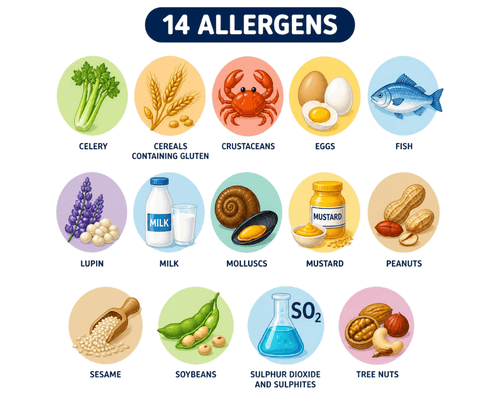
What are the 14 Major Allergens in Food?
The 14 major allergens in food and nutrition apply to all edible products, including additives, flavourings and processing aids. They are defined by the Food Standards Agency as:
- Celery
- Cereals containing gluten
- Crustaceans
- Eggs
- Fish
- Lupin
- Milk
- Molluscs
- Mustard
- Peanuts
- Sesame
- Soybeans
- Sulphur dioxide and sulphites
- Tree nuts
1.2 ELIMINATE ALLERGEN CONTAMINATION
Improving Allergen Control in Food Manufacturing
Poor allergen management can put consumers at risk and lead to serious operational, legal and reputational consequences for a business. Growing consumer awareness, tighter labelling requirements and increasing market demand are forcing manufacturers to take allergen control more seriously.
Effective allergen control is not only about compliance, but also about improving flexibility, protecting product quality and supporting more efficient production. For manufacturers handling powders, the right containment and handling approach can help reduce risk while enabling faster changeovers and stronger overall performance.
It is important to identify the everyday operational risks that can compromise product safety, including mis-labelling, airborne dust, open transfer points and equipment that is difficult to clean.
1.3 MANUFACTURING EQUIPMENT FOR ALLERGEN CONTROL
What Causes Cross‑contamination in IBC Powder Handling Systems?
Cross-contamination in IBC powder handling systems is usually caused by residual material left behind after cleaning, airborne dust released during transfer, and powder build-up in areas where product flow is restricted. Even small traces of previous ingredients or allergens can then enter the next batch and compromise product safety.
Leakage from poorly sealed connections can increase this risk further by allowing powder to escape or unwanted material to enter the process. Human error, including incorrect labelling, shared tools and inconsistent cleaning practices, can also contribute to cross-contamination.
Effective allergen control depends on robust factory procedures, including correct raw material storage, clear batch control, validated cleaning and well-trained operators. A well-designed powder handling system can strengthen allergen control, protect product integrity and help your operation run with greater confidence.
What is the Best Closed Powder Handling System for Allergen Control?
Matcon’s powder handling systems support allergen control by using sealed IBCs to contain powders throughout processing, storage and transfer, helping to prevent allergenic materials from escaping into the production environment. During discharge, Matcon’s unique Cone Valve technology maintains a dust-tight seal, eliminating powder leakage and reducing the risk of cross-contamination between batches and process equipment.
Because the IBC also acts as the blending vessel, manufacturers can separate recipes more effectively and remove the need to clean the mixer between every batch within a production shift, improving both hygiene control and efficiency.
/Allergen-WP-front-cover-single-1.webp "Allergen-WP-front-cover-single-1")
1.4 ALLERGEN HANDLING BEST PRACTICE GUIDE
How Decoupling Improves Food Manufacturing
As product ranges expand and legislation evolves, your facility must be ready to handle potentially hazardous ingredients, including allergens.
Learn how to design a flexible, efficient production system that controls allergen risk while also creating new opportunities for product growth.

2.1 DEFINING TRACEABILITY
The Importance of Ingredient Traceability in Food Manufacturing
What is Ingredient Traceability?
Ingredient traceability is the ability to track raw materials and ingredients from source to finished product. It helps manufacturers identify affected batches quickly, support accurate recalls, verify label claims and meet legal requirements. In practice, this is achieved by assigning lot or batch numbers to ingredients and tracking them through processing, packaging and distribution.
Why Traceability Matters
- Food safety and recalls: traceability enables manufacturers to quickly identify the source of an issue and recall only the affected batches, reducing risk to consumers and avoiding unnecessary cost.
- Quality and trust: it provides evidence that on-pack claims – such as organic, non-GMO, fairtrade or allergen-free – accurately reflect what is in the product.
- Legal compliance: for example, in the UK and EU markets, maintaining “one step back, one step forward” supply chain records is a regulatory requirement for all food businesses.
2.2 SYSTEMS & EQUIPMENT FOR TRACEABILITY
What is a Traceability System for Food Manufacturing?
Strong traceability depends on clear supplier communication, careful control of raw materials and robust procedures to prevent cross-contact during processing. A good traceability system should include routine testing for allergens at critical points in production, so any breach is identified early and contained before product leaves the site.
Cleaning processes need to be clearly defined, validated and rechecked regularly to prove that residues have been removed to acceptable levels. Alongside this, reliable digital records should capture every test result, cleaning verification and batch movement, creating a complete audit trail that supports swift, targeted recalls and gives customers and regulators confidence in your operation.
Another key focus is how ingredients are moved through the facility, as sealed, labelled containers and well-controlled transport routes can reduce dust release, operator error and cross-contamination risk. Learn how automation can strengthen traceability and improve control across the manufacturing process.
British Bakels
Handling a high recipe variety including allergens.

SternMaid
The flexibility to produce highly customised food products.

Spice Blending
Improving production capacity without facility expansion.

3.1 FOOD MANUFACTURING REGULATIONS
What Food Manufacturing Regulations Do Manufacturers Need to Be Aware of?
Food safety is not only about preventing harm to consumers, but also about meeting the regulatory requirements that apply in every market where products are sold. For food manufacturers, regulation spans the full production and supply process, so systems, documentation and controls must all work together to protect consumers and support legal compliance. Because food contact rules differ across regions, manufacturers must recognise the standards for each region.
While regional laws, such as EU Food Safety Policies, dictate local enforcement, manufacturers worldwide align their compliance through international frameworks established by the UN and the Global Food Safety Initiative (GFSI), such as the Codex Alimentarius. These provide a reference point for food safety standards, codes of practice and guidance. The table below is a non-exhaustive list of some of the globally recognised regulatory frameworks for consumables.
| Regulatory Framework / Standard | Jurisdiction / Scope | Key Requirements for Manufacturers |
| Codex Alimentarius | Global | International food standards, guidelines, and codes of practice established by the FAO and WHO. Serves as the global baseline for fair trade and consumer protection. |
| HACCP Principles | Global | A scientific, preventive system requiring hazard analysis, identification of critical control points (CCPs), critical limits, monitoring, and corrective actions. |
| ISO 22000 | Global | An international standard developed by the International Organization for Standardization that maps out a comprehensive food safety management system covering all stages of the supply chain. |
| BRCGS Food Safety | Global (GFSI-Benchmarked) | Commonly used framework for supply chain due diligence, requiring strict operational controls, product integrity, and an enforced food safety culture. |
| FSMA (Food Safety Modernization Act) | United States | Requires every food facility to implement preventive controls and supply chain verification programs for imported goods. |
| General Food Law (Reg 1169/2011) | European Union & UK | Mandates strict traceability (one step forward, one step backward), accurate labeling, allergen disclosure, and rapid product recall processes. |
| FSSAI | India | Sets mandatory controls on processing environments, rigorous import/export inspections, and specific guidelines for front-of-pack nutrition labeling. |
As an example of regional legislation, the Food Standards Agency highlight the main UK food laws that underpin food safety, standards, traceability, labelling and recalls. Under the Food Safety Act 1990, food businesses must ensure food is safe to eat, meets the quality consumers would reasonably expect, and is not labelled or presented in a misleading way. Alongside this, the General Food Law covers food imports and exports, safety, traceability, labelling, and product withdrawals and recalls. This is particularly relevant for manufacturers because it links regulatory compliance directly to the ability to track products and act quickly if issues arise.
How Does Certification Support Compliance in Food Manufacturing?
Certification is not just an audit exercise, but a structured way to build trust, reduce risk and strengthen operational control. The process involves an independent assessment of a company’s site, systems and procedures against the requirements of the standard, and businesses must maintain compliance with the latest version. It can help reduce waste, rework and recalls by improving control and consistency across the production process, giving organisations a practical way to monitor and improve food safety performance over time. In the event of a food safety incident, certification helps to demonstrate due diligence, which can support legal defence and protect the manufacturer's reputation.
For example, the BRCGS Food Safety certification is a globally recognised, GFSI‑benchmarked standard that provides a clear framework for managing food safety based on a robust quality system, HACCP and core prerequisite programmes such as GMP, GLP and GHP.
3.2 REGULATORY COMPLIANCE
The Need to Comply With Regulation
FSMA regulations are designed to move food manufacturing away from reacting to contamination incidents and towards preventing them before they occur. Manufacturers are expected to identify hazards in advance, put robust controls in place and prove that these controls are working consistently day in, day out. Crucially, these requirements apply not only to producers based in the USA, but also to any overseas facility that exports food products into the US market. For global brands and their suppliers, FSMA compliance is therefore both a legal obligation and a practical framework for building safer, more resilient operations.
To meet these expectations, manufacturers need hygienic process design, clear end‑to‑end traceability, validated cleaning procedures and tight control of cross‑contamination risks at every stage of production. Closed, container-based handling systems help by keeping batches physically separate, strengthening allergen control and generating the audit-ready records regulators now expect. Crucially, this level of compliance does not have to reduce agility – with the right system design, you can still achieve fast changeovers and run a wide variety of recipes efficiently.
3.3 HYGIENE STANDARDS
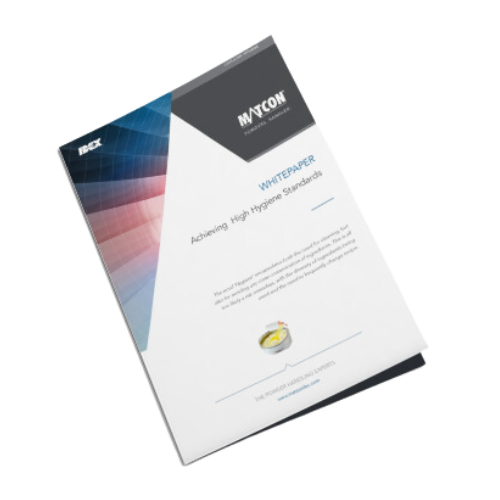
Meeting Food Hygiene Standards
Maintaining rigorous hygiene should not mean excessive cleaning or long periods of downtime. Completely stripping a line between every recipe change is possible in theory, but in practice it is costly, time‑consuming and restricts throughput.
The Matcon IBC system is engineered to minimise cleaning while still ensuring that no traces of the previous batch remain. This allows you to run a flexible, high‑mix production environment without compromising hygiene standards – helping you protect both your brand and the end consumer.


I'm Responsible for Engineering


I'm Responsible for Operations


I'm Responsible for Management

POWDERS, HANDLED
We Solve Your Powder Handling Problems
Matcon's powder handling equipment includes our patented Cone Valve Technology, which ensures that we can overcome all manner of powder flow and containment problems.

Powder Bridging
Solve and prevent powder flow issues that result in powder bridging upon discharge.

Rat Holing
Common in fine or sticky powders, ratholing can lead to costly powder flow problems.

Containment
Meet hygiene and safety requirements and remove the risk of cross-contamination.

Powder Mix Segregation
Overcome the segregation of your powder mix to ensure you achieve mass flow.