Feeding Dry Granulation with IBC Systems for OSD Manufacturing
Consistent, segregation-free powder delivery is one of the most critical requirements in dry granulation for OSD manufacturing. The quality of granules produced by roll compaction depends directly on the quality of the material being fed into the process. Any variation in blend uniformity at this stage can affect the final product and put quality targets at risk.
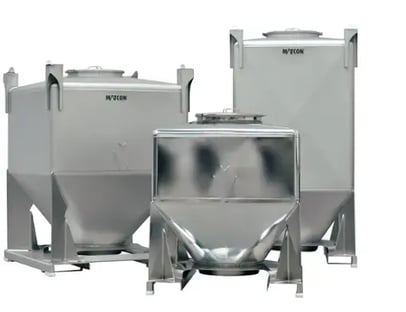
Matcon IBCs are well suited to this application thanks to the superior Cone Valve technology within each IBC, which creates mass-flow discharge, which means every particle moves through the container at the same rate. This prevents de-mixing during transfer and delivers a controlled, consistent feed of blended powder to the roller compactor, every time.
Why Preventing Blend Segregation Matters in Dry Granulation
Segregation during feeding is one of the most common causes of quality failure in dry granulation. When particle sizes or densities differ even slightly, conventional discharge methods can cause heavier particles to separate from lighter ones before they reach the compaction rollers. This leads to inconsistent granule density, variable tablet hardness, and potential batch rejection.
Matcon's Cone Valve IBCs address this directly. The mass-flow discharge pattern ensures the full blend moves as a uniform mass, not in channels or preferential flow paths. Independent testing and real-world pharmaceutical installations confirm that this approach maintains blend homogeneity right up to the point of compaction.
Related Pages
Click on the links below to access the other processing steps:

How Does the Cone Valve Prevent De-mixing During Powder Transfer?
The Cone Valve sits at the outlet of each IBC and controls how powder exits the container. Unlike a standard butterfly valve or slide valve, the Cone Valve lifts upward into the powder bed to open, which activates the entire base of the IBC and promotes mass-flow through the annular gap. Every part of the powder bed moves downward at the same rate, which eliminates the risk of powder channelling or particle separation during discharge.
This is especially important when feeding dry granulation equipment, where even small amounts of segregation can compromise granule uniformity. The Cone Valve also generates a gentle pressure pulse that keeps powder moving smoothly, even with materials that tend to bridge or stick. Even the more sticky powder of metformin which is notorious for bridging inside containers and discharging unevenly.
Reliable Powder Transfers
Meeting QbD requirements in pharmaceutical manufacturing means being able to demonstrate consistent, repeatable process performance. That starts with reliable material transfer.
If the feed to your roller compactor is inconsistent, the process cannot be fully controlled, and QbD targets become difficult to meet.
How do IBCs Compare to Fixed Hoppers for Dry Granulation Feeding?
Fixed hoppers are a traditional choice for feeding roller compactors, but they come with significant limitations. They require dedicated installation, are difficult to clean between product changeovers, and often struggle with cohesive materials that tend to arch or bridge at the outlet. They can become a higher maintenance burden as cleaning a fixed hopper in a pharmaceutical environment is time-consuming and carries the risk of cross-contamination if not done thoroughly.
IBCs offer a more flexible and hygienic alternative. Because each IBC is a self-contained unit, it can be cleaned offline while production continues with a second container. This decoupled approach reduces cleaning downtime.
Key Features of Matcon IBC Feeding to Dry Granulation
- Mass-flow discharge ensures no blend segregation during powder transfer
- Overcomes bridging of sticky and cohesive materials such as metformin
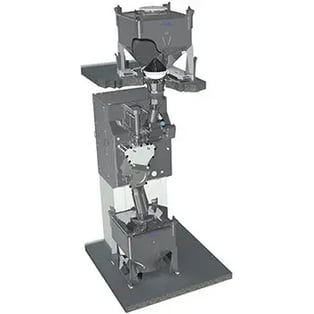
- Controlled and reliable powder feed to roller compaction equipment
- Fully automatic operation with no manual intervention required
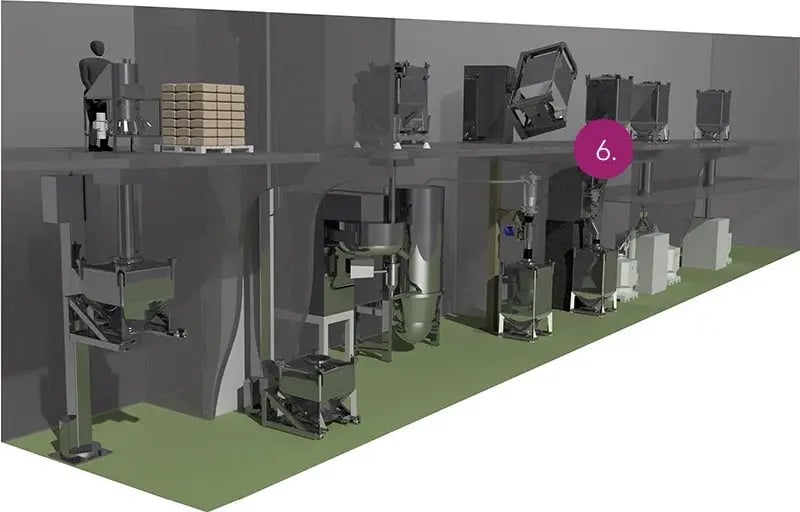
- Single-floor or through-floor options to suit your facility layout
WHITEPAPERS
A Better Way To Handle Tablets Using IBCs
Handling tablets in larger batches using IBCs reduces the amount of labour needed to move containers and make and break connections at each stage of the tablet finishing process. Fewer transfer events mean better control, stronger traceability and recording throughout tablet processing.
A single Tablet IBC can replace multiple drums and offers automatic filling capabilities, while reducing the risk of breakage or damage during transfer. For operations running high volumes of tablets, moving from drums to IBCs at the tablet handling stage delivers measurable improvements in throughput and production efficiency.

Frequently Asked Questions About Feeding to Dry Granulation:
Blend segregation during roller compactor feeding usually happens when powder particles of different sizes or densities separate during discharge or transfer. This can occur with conventional valves or hoppers that allow channeling or preferential flow.
Matcon Cone Valve IBCs prevent this by creating mass-flow discharge, where the entire powder bed moves uniformly and no particle separation occurs before it is discharged and transferred into the compaction process.
Yes. The Matcon Cone Valve technology is specifically effective with cohesive and sticky materials that tend to bridge inside standard containers. The valve lifts upward into the powder bed and generates a gentle pressure pulse that breaks any bridges forming at the outlet. This ensures continuous, uninterrupted powder flow even with difficult materials like metformin.
Quality by Design (QbD) requires consistent, repeatable process inputs. When powder feed to a roller compactor is unreliable or segregated, the granulation process becomes variable and difficult to control.
Matcon IBCs deliver a uniform, measured feed that is fully automatic and repeatable, which gives manufacturers the process consistency they need to meet QbD targets and satisfy regulatory expectations.
Matcon IBC systems for dry granulation feeding are available in single-floor and through-floor configurations. This makes them suitable for a wide range of facility layouts.
Through-floor installations use gravity to support powder flow and reduces the need for mechanical conveying, which in turn lowers the risk of segregation or product damage during transfer. For manufacturers planning a new facility or upgrading an existing line, both options offer practical flexibility. You can explore further considerations in our guide to single versus two-floor pharmaceutical facility design.
Yes. Matcon IBCs are designed to move between process steps without the product being transferred to another container. The same IBC used for blending the pharmaceutical ingredients can be transported to connect directly to the dry granulation feeding station.
This closed, contained approach protects blend uniformity, reduces handling steps, and cuts the risk of contamination or product loss between blending and compaction.