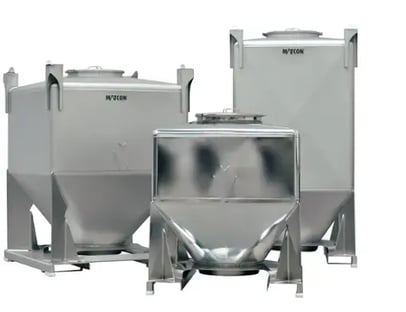
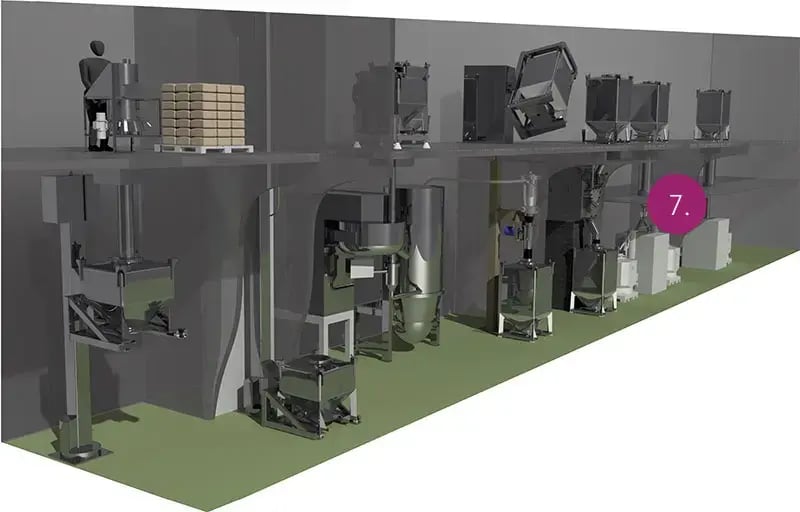
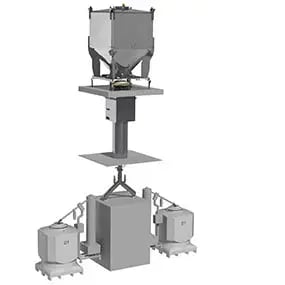
Reliable Feeding to Tablet Press with Matcon IBCs
The Matcon Cone Valve, fitted within the outlet of each IBC, feeds product directly into the tablet press quickly and automatically. Because it creates mass-flow discharge, all particles move down through the IBC together. This keeps the blend uniform from the first tablet to the last, protecting content uniformity (CU) throughout the entire discharge process.
Traditional butterfly valve bins cannot reliably guarantee this, which makes the Cone Valve IBC a clear step forward for pharmaceutical manufacturers.
Why Does Blend Uniformity Matter When Feeding a Tablet Press?
Content uniformity is one of the most closely watched quality measures in tablet manufacturing. If the powder blend separates during discharge, the active ingredient concentration will vary from tablet to tablet. This creates batch failures, regulatory risk, and wasted production time.
Matcon IBCs promote mass-flow discharge which keeps every particle moving at the same rate, so the blend that leaves the blender arrives at the tablet press exactly as it was intended, without any blend separation.
How Do Matcon IBCs Handle Difficult Powders?
Not all powders behave well during the OSD pharmaceutical manufacturing process steps. Some bridge across the outlet of the container, others form rat-holes that stop flow entirely, and some compact over time or stick to container walls.
Matcon IBCs are designed to prevent all of these problems. Also preventing material retention and material sticking to walls, which would affect the consistency of feed to the tablet press.
The Cone Valve applies a gentle, controlled pressure pulse to break any compaction and promote smooth, consistent flow. This is especially important when handling notoriously challenging active pharmaceutical ingredients such as metformin, where inconsistent flow directly threatens tablet quality. Take a look at our case studies for proof.
What Feeding Problems Can the Cone Valve Solve for Pharmaceutical Manufacturers?
Pharmaceutical manufacturers commonly face three feeding problems: inconsistent flow rates, powder segregation during transfer, and material sticking to container walls causing retention.
The Matcon Cone Valve addresses all three in a single, integrated system. Controlled mass-flow prevents segregation. The valve's active discharge mechanism and annular flow eliminates bridging and rat-holing. Smooth internal surfaces with no ledges or dead zones prevent powder retention. The result is a feeding process that is repeatable, auditable, and suited to high-volume tablet production.
How Does Cone Valve IBC Feeding Compare to Traditional Butterfly IBC Systems?
Traditional butterfly valve bins discharge in a funnel-flow pattern, where material in the centre flows first and material at the walls moves last. This can cause the blend to separate by particle size and density before it even reaches the tablet press.
IBCs with Cone Valve technology eliminates this by ensuring all material moves as a single, uniform mass. This delivers a good blend quality and a consistent flow of material to the tablet press enabling you to optimise efficiency. For a broader look at how IBC systems improve pharmaceutical production, see our guide on pharmaceutical manufacturing best practice.
Key Features of Matcon IBCs Feeding to Tablet Presses
- Compatible with single-sided or double-sided tablet presses
- Suitable for use with double-layer tablet presses
- Large batch transfers supported
- High processing efficiency throughout the production cycle
- Single-floor or through-floor feeding capability
Related Pages
Click on the links below to access the other processing steps:

WHITEPAPERS
A Better Way To Handle Tablets Using IBCs
Handling tablets in larger batches using IBCs reduces the amount of labour needed to move containers and make and break connections at each stage of the tablet finishing process. Fewer transfer events mean better control, stronger traceability and recording throughout tablet processing.
A single Tablet IBC can replace multiple drums and offers automatic filling capabilities, while reducing the risk of breakage or damage during transfer. For operations running high volumes of tablets, moving from drums to IBCs at the tablet handling stage delivers measurable improvements in throughput and production efficiency.

Frequently Asked Questions About Feeding to Tablet Presses:
Mass-flow discharge means every particle in the IBC moves downward at the same rate, flowing through the annular gap at the IBC outlet, with nothing staying behind and nothing racing ahead.
This matters for tablet press feeding because it keeps the powder blend exactly as it was prepared and maintains the blend uniformity. If particles of different sizes or densities move at different speeds, the blend separates before it reaches the press, causing tablets with inconsistent active ingredient levels.
Yes. Matcon IBCs are compatible with both single-sided and double-sided tablet presses, as well as double-layer tablet presses. The system is designed to feed a consistent, controlled stream of powder regardless of the press configuration, making it suitable for a wide range of tablet manufacturing setups. The size of the IBC can be matched to the throughput rates.
The Cone Valve uses a controlled lifting and lowering action at the IBC outlet to break any compaction or bridging that forms in the powder bed.
Rather than relying on gravity alone, the valve actively promotes flow by applying a small, measured force and vibration at the top of the lift. This makes it reliable even with powders that are known to compact, stick together, or arch across the outlet.
Each IBC can be tracked throughout the production process, from dispensary through blending to tablet press feeding.
This means every batch of tablets can be linked to a specific container, a specific blend record, and a specific transfer event. This level of traceability supports GMP compliance and makes deviation investigations faster and more accurate.
For more on how IBC systems support pharmaceutical operations, visit our pharmaceutical operations page.