EFFICIENT, EFFECTIVE, FLEXIBLE
IBC Blenders & Industrial Powder Mixers
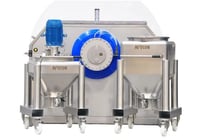
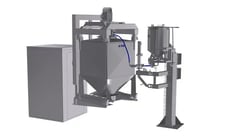
In-bin blending using Matcon IBCs increases flexibility and agility on your production line by keeping each recipe in its own sealed container. Because the IBC itself is the blending vessel, there is no need to clean down the blender between batches – you simply remove the finished IBC and switch in a fresh batch IBC for fast, repeatable changeovers.
Tumble blending offers gentle mixing of fragile powders, with the option to add high shear mixing when a more vigorous process is required.
High Containment
Resolves Powder Flow Issues
Improved Efficiency

Powder Handling System Modules
Matcon's blending capabilities are just one element of the efficient powder handling systems we offer. Our processing equipment helps you at every stage of your powder handling process, streamlining your operations, improving product quality and helping increase your margins. By decoupling the manufacturing steps, we enable manufacturers to achieve a flexible and efficient powder handling system.
Industrial Blending Equipment
Frequently Asked Questions
Matcon industrial blending systems can handle batch sizes from 50L to as high as 3,300L.
For production-scale blending, the Matcon IBC Blender can handle batch sizes of 500L to 3,300L, with the ability to fill IBCs at 20% of capacity for greater batch flexibility.
For smaller-scale development work, Pilot Scale blenders are available in 50L to 200L, making them ideal for recipe development, proof-of-concept work, and low-volume batches.
One Matcon blender can accommodate a range of IBC sizes, which helps manufacturers handle varied batch volumes on the same equipment. This makes Matcon blending systems suitable for both low-volume product development and larger-scale industrial powder blending where flexibility and efficient changeover are important.
Homogeneous blending time is not fixed; it depends on the recipe, ingredient properties, batch size, and the process settings used on the blender.
In practice, the right blend time is usually established during product trials. At Matcon, we are able to use NIR spectroscopy to show in real time when the powder has reached the required level of homogeneity. This approach helps confirm the minimum mixing time needed for each recipe, and that it is often significantly less than a customer’s current mixing system.
The most accurate answer is that homogeneous blending may take only a few minutes for some powders, but the typical time should always be validated for the specific formulation using trials and real-time measurement.
The main difference between ribbon blenders and tumble (IBC) blenders is that ribbon blenders mix product inside a fixed trough using internal agitators, while tumble blenders mix powder by rotating the Intermediate Bulk Container (IBC) itself.
Ribbon blenders can be suitable for fast mechanical mixing, but they typically require the blender to be cleaned between batches because the machine has product-contact parts. Tumble (IBC) blenders are often preferred where containment, hygiene, and frequent recipe changeovers are important, because the product remains inside the IBC and the container can be cleaned offline while the blender stays in production.
Matcon blending equipment builds on this IBC approach by supporting contained blending, fast changeovers, and optional high shear or liquid addition for more demanding powder recipes.
PROVEN CAPABILITIES
Global Testing Facilities
At Matcon, we want to ensure you have access to the right equipment and specifications you need to produce a high-quality end product. Materials, environment, humidity and powder characteristics all play a huge part in influencing how powders will behave during blending, packing or even in transit. Our state-of-the-art test plants give you the opportunity to test your product mixes with our equipment in a controlled environment.
Test Centres
Our state-of-the-art Test Plants are designed to simulate actual working conditions using your individual recipes, giving you peace of mind that your test results represent real world operations.
United Kingdom
Full-scale equipment capabilities including Near-Infrared (NIR) spectroscopy, allergen swabbing & lab testing equipment.
USA
Full-scale equipment capabilities including blending, formulation & cleaning.
China
Full-scale equipment capabilities including blending, formulation & cleaning.