


Food and nutrition manufacturers need to increase production in order to grow their business, but not all have the budget or space to expand their factory building. There is a solution that you can apply to your facility with simple phased steps. In this 2nd part of our blog series on increasing production in a smaller space, we walk you through this phased approach to implementing a flexible manufacturing system into your facility.
This is part 2 of our series. Part 1 explains the agile production system and the timings behind it.
When is change worth making?
We understand that any changes to an existing production line involves investment in time and money. It is easy to put off even the most fundamental upgrades to equipment but if these changes were:
- Obviously going to save costs, improve quality, increase production and revenue. You know the upheaval and initial investment significantly out-weigh the benefits.
- Could be proven to work for your specific ingredients, in your facility before the project commenced.
- Would be implemented in satisfactory phased steps.
The Solution to Increased Productivity Without Expansion
Introducing a mobile, contained system.
Imagine being able to pre-fill, blend your ingredients, pack and clean all at the same time! In using IBCs (Intermediate Bulk Containers) which are sealed mobile units that come in a variety of sizes (from 50L to 3500L) all of these processes can be actioned simultaneously saving so much time.
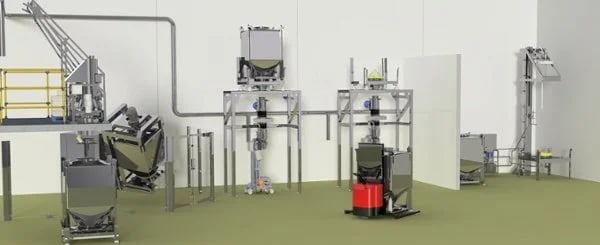
After working with a tremendous number of manufacturers over 40+ years, supplying the best equipment solutions, we have learned what works best for food and nutrition manufacturers. This is why we provide a pre-proven, phased approach to implementing a flexible production process. This method removes the usual risks involved with investing and implementing new equipment.
Our Phased Approach
This step by step method means that we/you can stop at any moment of the process if you consider improvements are not possible or won’t work with your specific recipes.
Our Phased Approach looks a bit like this:
- Information Discovery
You tell us about your product, operations and facility layout and any issues you’d like to solve e.g. you’d like to increase your production levels but feel that your operators and processes can’t work any faster or more efficiently than they do currently (we are always happy to prove the efficiency of our equipment). We understand that time spent upfront understanding your full processes and business objectives, both for today and the future are important. We have frequently built ‘lines of the future’ for clients and ensured that they are future-proof and able to respond to changing customer demands and the different ingredients that my be invented.
- Site Visit
It is ideal if we can visit your site to walk your factory floor, take scans of the production space and make an audit to understand your business, chat to you and the operators that have hands on experience in the day to day running of your facility. We may also see things that you take for granted, which can be influential on the final design.
- Technical Proof
Seeing your specified equipment in action, blending your actual product recipes provides a huge amount of re-assurance for our clients. If you need proof of concept, testing can be arranged at one of our global testing facilities using your recipes, ingredients and the specified equipment at production scale. You can analyze your tested, final product to gain extra reassurance that the ingredients are mixed and are discharged into their final packs without separation of mix.
- Historic Data
Over our decades of experience, we have collated vast amounts of data on numerous products produced around the world. We can tap into this archive to see any similarities with your ingredients and how challenges have previously been over-come and efficiencies made. Of course, we won’t share the details, but we use our knowledge to advise.
- Objectives
We like to fully understand your goals and quantify them e.g. double tonnes of product by next year / increase ROI by X etc. Then this helps us to design in the right number of IBCs and Blenders to ensure you get the maximum production capacity and a high OEE (Overall Equipment Effectiveness) rate. Our IBC system is modular, so we can configure the elements in a multiple of different ways to suit your needs & site layout.
- Road Map
We create a road map of your current manufacturing line-up compared to how your future system could look. You can start small with just decoupling your fixed mixer, and formulating the recipe offline into IBCs that can then be rapidly discharged into the mixer, to save on formulation downtime. Then more IBCs can be added to receive the blended mix and feed to packing or any other downstream process. The next stage would be to add in an IBC Blender which delivers full flexibility to the system. Then as you grow, over time, you can add more Blenders and IBCs and Discharge Station points to expand the production line.
- Implementation
When you feel confident in your decision, we work with you to plan in the implementation & installation. We also offer regular Servicing Agreements and have a responsive Spares team who will ensure your equipment is well cared for once you take ownership. And as part of one of the World’s biggest multinational manufacturers (IDEX) you have the assurance that the system you put in place will be supported for years to come.
Why Does Every Project Start with an Audit?
Every customer is different. From your batch sizes, the type of powders being processed, the location of your facility and the nuances of your current system. Even differing recipes, the origins of your source materials, particle size and texture of your powders, these all influence your end product. Knowing your existing manufacturing processes is the only way to ensure we deliver what we promise, which is why every engagement begins with a thorough audit of your needs.
Frequently Asked Questions
How can food manufacturers increase output within their existing facility?
Food manufacturers can increase output within an existing facility by using the space in a more efficient way. As a starting point the full batch cycle should be measured, not just blending time. From here the bottleneck can be identified and steps designed to overcome, such as running processing stages in parallel .. A mobile, contained IBC system allows pre-filling, blending, packing and cleaning to happen across multiple batches at once rather than waiting on one fixed mixer. It occupies a smaller footprint, but can have a higher capacity potential.
Map the full batch cycle: filling, blending, discharge or packing, cleaning and validation.
Identify which stages can run in parallel.
Confirm the equipment can handle the required recipes and batch sizes while preserving quality and hygiene.
Test changes against your actual ingredients, recipes, layout and quality requirements, using a phased approach before committing further.
How can reducing work-in-progress inventory free up food manufacturing space?
Reducing work-in-progress inventory frees space by producing to order size rather than filling a large mixer to capacity. Less surplus product in storage releases floor and warehouse space, avoids tying up capital in excess stock, and reduces the risk of stock expiring before sale. Different-sized IBCs and adjustable fill levels help match batches to orders.
How can manufacturers determine whether they need more space or better equipment utilisation?
To tell whether you need more space or better utilisation, map the full production cycle and record how long equipment is unavailable at each stage. If idle time and bottlenecks dominate, the constraint is utilisation, not floor space, and decoupling stages may unlock capacity without expansion.
Also review layout, equipment footprint, material movement between stages and the space needed at each step; poorly planned material handling can limit capacity even when the footprint is unchanged.
Validate any proposed changes against actual process times before deciding expansion is necessary.
