


[Updated for 2026]
Dairy manufacturers are under growing pressure to increase production flexibility while maintaining efficiency, product quality, and regulatory compliance.
Changing consumer preferences, expanding product portfolios and demand for smaller batch sizes mean manufacturers need production processes that can adapt quickly without increasing downtime or operational complexity.
For dairy manufacturers in particular, the growth of specialist dairy ingredients, milk powders, nutritional products and high-protein formulations is creating new demands on both manufacturing processes and equipment.
As a result, flexible manufacturing systems and dairy manufacturing equipment are becoming increasingly important for businesses looking to remain competitive in a rapidly evolving market.
What trends are changing dairy manufacturing?
Dairy powder portfolios have moved beyond standard milk powder. The growth areas are:
● High protein products and protein powders
● Fortified milk powders
● Nutritional blends (including infant nutrition)
● Specialist dairy ingredients
What issues does this create for dairy products?
More recipes on shared equipment
Most dairy manufacturers run their whole portfolio through the same blending and packing equipment. Every extra variant adds another changeover.
Milk is itself an allergen
Milk is one of the 14 major allergens. Many dairy sites also handle soya, nuts, cereals or egg in fortified and nutritional products. Running all of these on the same line demands strict separation and validated cleaning. As the portfolios grow, those requirements take up more production time.
Read our guide on safety, compliance and allergen control in food manufacturing here.
Blend consistency in dairy powders
Fortified and nutritional blends combine powders with very different particle sizes and densities. Those blends can segregate during handling, which results in rejected batches becoming a serious problem when a label declares a nutritional value.
Cost and labour pressure
Rising operating costs and labour shortages are pushing dairy sites to remove non-value-added work such as excess cleaning, waiting, and manual handling. That makes Overall Equipment Effectiveness (OEE) a priority.
What dairy manufacturing equipment improves production flexibility?
Equipment that removes mixer cleaning between recipes
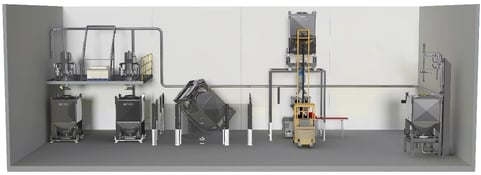
IBC blending systems mix the product inside a sealed container, so the blender itself never touches the powder. The next recipe can go on the blender straight away while used IBCs are cleaned offline. Systems that reduce cleaning requirements free up production time without lowering hygiene standards.
Flexible batch sizes
IBCs come in a range of sizes, so one blender can handle a small run of a specialist nutritional blend and a large run of a core product. See how smaller batches increase flexibility.
Segregation-free discharge
Matcon's Cone Valve discharges the blend in mass flow, so the mix that reaches the packing line matches the mix that left the blender.
Equipment that fits the building
Dairy sites often have height limits. Mobile IBC systems avoid tall fixed mixing towers. Read flexible mixing solutions for food and dairy facilities.
Real-World Production Flexibility Challenges
Many food and dairy manufacturers face common challenges related to powder handling, product consistency, and downstream processing.
One example is the production of 3-in-1 coffee and tea beverages, where powder segregation and uncontrolled discharge can lead to inconsistent product quality and variable pack weights. These issues can affect operational efficiency as well as customer satisfaction and brand reputation.
To address these challenges, manufacturers increasingly seek technologies that can maintain blend of integrity and deliver controlled, reliable material flow throughout the production process.
Supporting High-Growth Food and Dairy Applications
Demand continues to rise across a number of dairy sectors. These applications often involve multiple recipes, numerous ingredients and varying batch sizes, making production flexibility especially important. Maintaining blend of homogeneity, ensuring traceability and achieving consistent product quality can become increasingly complex as product portfolios expand.
Flexible manufacturing systems enable manufacturers to adapt quickly to changing market requirements while maintaining efficiency and quality standards. This helps businesses support growth without compromising operational performance.
Optimising Manufacturing for the Future
As dairy markets continue to evolve, manufacturers need production systems that provide both flexibility and efficiency.
Whether managing smaller batch sizes, responding to changing consumer demand or expanding product portfolios, businesses must be able to adapt without compromising quality or productivity. Flexible manufacturing solutions and dairy manufacturing equipment that support efficient changeovers, reliable powder handling and scalable production can help manufacturers meet today's challenges while preparing for tomorrow's opportunities.
By investing in systems designed to improve production flexibility, food and dairy manufacturers can increase efficiency, maintain product quality and position themselves for long-term success in an increasingly competitive marketplace.
Frequently Asked Questions
How can food manufacturers manage a growing number of SKUs efficiently?
Food manufacturers can manage growing SKU counts by prioritising production flexibility and checking whether changeovers, cleaning and equipment preparation, rather than nominal capacity, are constraining throughput. Intermediate Bulk Containers (IBCs) can decouple process stages so different SKUs are processed in parallel, reducing transfer containers, cleaning steps and residue.
More SKUs add complexity through extra recipe changes, ingredient handling, batch changeovers, cleaning cycles, quality checks and traceability requirements.
What are the benefits of reducing changeover times in food manufacturing?
Reducing changeover times gives equipment more time to produce saleable product, increasing utilisation and batches per shift. Faster changeovers also improve responsiveness to demand, make smaller and more varied production runs viable, and reduce excess stock that might otherwise become obsolete or be discarded.
Running process stages in parallel amplifies the benefit: for example, mixing one batch while an IBC is cleaned or filled for the next recipe keeps production equipment from sitting idle.
How can manufacturers prevent powder segregation during production?
Powder segregation can occur during storage, transfer and discharge, resulting in inconsistent blends and reduced product quality. Equipment and handling systems designed to maintain mass flow and blend homogeneity can help preserve product consistency throughout the manufacturing process.
What are the biggest challenges facing dairy manufacturers today?
Many dairy manufacturers face challenges including product diversification, shorter production runs, strict hygiene requirements, increasing operational costs and the need to maintain consistent product quality. Flexible production systems can help address these challenges while supporting future growth.
How can food and dairy manufacturers reduce product waste?
Improving material handling, preventing segregation and maintaining process consistency can help reduce waste throughout production. Efficient manufacturing equipment also helps minimise product losses during transfer, blending and discharge operations.
What should manufacturers look for when investing in dairy manufacturing equipment?
Key considerations include production flexibility, scalability, cleaning efficiency, hygiene standards, product quality protection and long-term operational performance. Equipment that can adapt to changing production requirements is often better positioned to deliver value over time.
If you would like to find out more about flexible food production and how to optimize your manufacturing process and improve product quality, please get in touch.
